

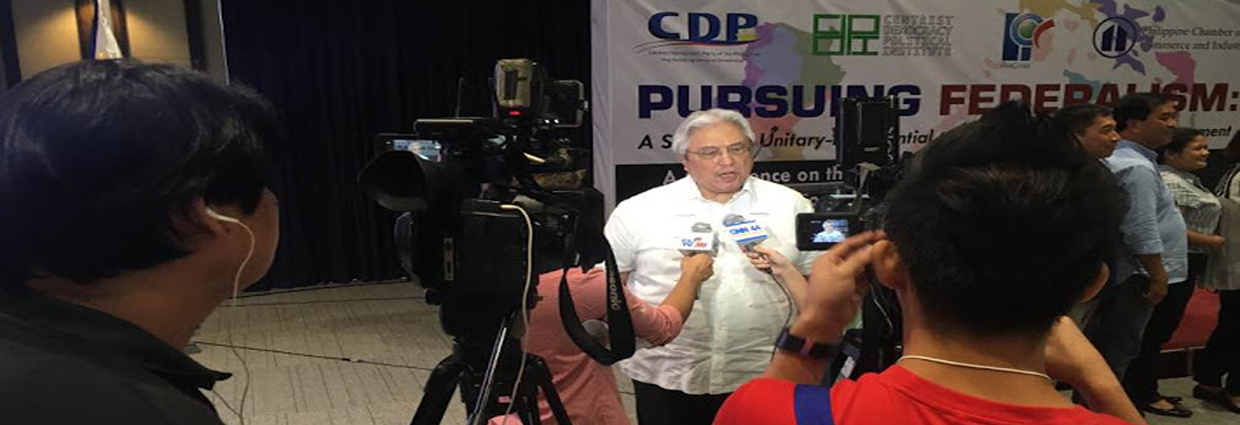
Kusog Mindanaw, BARMM and federalism

Last of 2 parts
FOR the past three decades, Kusog Mindanaw (Kusog) was the premier platform for its various stakeholders to air their concerns, gripes and aspirations. The strategy was to achieve whatever consensus is to be arrived at in view of the diversity of cultures within one nation whose collective personality has been forged by the ascendency of two Western civilizations — Spanish and American — blended into a mongrelized pastiche, embodied in the centralized government lodged in Manila, the symbolic imperial seat. The task therefore was an ambitious undertaking encapsulated in a catch-all phrase encompassing our hopes — peace and development and unity in diversity through federalism.
Kusog has provided modest but critical contributions to the conception of both the defunct ARMM and the Bangsamoro Autonomous Region in Muslim Mindanaw (BARMM). Quite a few of their leadership were once active in these conferences. The adversaries MNLF and MILF met unofficially with the GOP (Government of the Philippines) peace panelists, seeking advantage by deducing each other's negotiating postures. The genesis of ARMM/BARMM may be traced to these political conversations shaped further in the fringes of intermittent internecine clashes against central authority.
From the second half of this century, this wretched land touted by the good people in Luzon as the land of promise indeed fulfilled its potential not for what our political patriarchs envisaged but by bloodletting. Starting with fierce fighting, land evictions and issues of who owns what were reduced to the question of redress of ancient grievances and the rectification of old injustices. But for whom and by whom has blurred and gone beyond semantics (see The Manila Times, Nov. 16, 2022, "Kusog Mindanaw" Part 1). All sides were right, and all sides were wrong. Guns and violence substituted for civilized behavior, senseless arbiters of disputes.
Cognizant of the diverse faiths of the protagonists, the Bishops-Ulama Conference (BUC) religious leaders provided spiritual guidance. The GOP side: the Confederation of Mindanao Governors, City Mayors, and Municipal Mayors and the Mindanao Legislators Association composed of congressmen and senators from Mindanao offered tutorials in governance. The Mindanaw business councils and local entrepreneurs propounded trade and markets. But the bulk, whose aspirations were to be served were the NGOs and POs, the academe, the cooperatives, the Mindanaw women and the Mindanaw media; and the mostly disenfranchised Lumads. They are the Kusog
BARMM a panacea?
The Mindanao Muslims' yearning for a "bangsa" of their own was the impetus for the BARMM, becoming a reality only as the culmination of intermittent countless wars, peace talks, peace failures and attempts at reconstructions and restructuring. But the sine qua non was that the BARMM was to exist within the ambit of the Filipino nation.
Thus, the concept of local autonomy and federalism copied from various countries around the world with different histories and values was put in place. The BARMM was indeed a truly local concept adapted after both sides — the Bangsamoro and the Philippine government — had exacted so much blood and had no other recourse.
Thus, an experiment on self-governance ensued stating in no uncertain terms its mission and vision: "The Bangsamoro that is united, enlightened, self-governing, peaceful, just, morally upright, and progressive. Guided by moral governance and in pursuit of genuine and meaningful autonomy, the Bangsamoro Government ensures the necessary conditions for enduring peace and sustained socioeconomic development suitable to the systems of life, needs, and aspirations of its people by providing services to communities, ensuring multi-stakeholder participation, and facilitating appropriate partnerships."
Beautiful words but one critical concept of this preamble is the final negation of what was once a primordial cry — independence and a separate nation. It is supplanted by a more logical genuine autonomy — planting the seeds of federalism. This too is Kusog's raison d'etre.
Kusog and BARMM
In the Kusog conference in November this year, the flavor of the dissertations and the discourse had changed. There were no longer clashes of ideas — thesis versus antithesis producing synthesis. Participants had become ambivalent. But having proudly contributed to the creation of the BARMM, Kusog must now move on to expand the concepts embodied by BARMM and agitate for other "bangsa in Mindanaw" for similar "pursuit of genuine and meaningful autonomy!"
Kusog needs to reinvent itself from solely a three-decade venue for discourse and debate to a more active participant in the development of BARMM as therein lies in its initial success, the fundamental restructuring of a unitary system of government. BARMM's uniqueness as a parliamentary government existing within a unitary Philippines could be the template for the next phase — the proliferation of BARMM clones — this time in the other Christian dominated regions in Mindanao and eventually the whole country. Let Mindanaw be first to move towards a truly Federal State.
What's good for Bangsa Moro is good for Bangsa Bisaya, Bangsa Ilokano, Bangsa Tagalog, Bangsa Bikolano and the other Bangsa making a total of 8 to 13 Bangsa of the Federal Republic of the Philippines. A new cry BARMM today! Pederal Mindanaw tomorrow! and Pederal Philippines beyond!
We Mindanaw-nons (this writer included) are under no illusion that many in the center of political power in the Philippine government would rather hold on to the monopoly of central authority and would not mind BARMM failing. But its failure or success depends to a large extent on how it governs itself.
Dark cloud looming
Two events happened just recently that may have a negative impact on BARMM's governance. Earlier this month reports filtered out that the 101st Infantry Brigade of the Philippine Army clashed with Bangsamoro Islamic Armed Forces (MILF-BIAF) in the town of Ungkaya Pukan in Basilan province. Basilan is now part of BARMM, and a decommissioning process of its armed forces is in the closing phase. Questions begin to surface: Was there a decommissioning of forces in the BARMM per agreements in the Comprehensive Agreement of the Bangsamoro (CAB)? Reports also came out that these were young men presumably recruited after the BARMM came into existence. Was the demobilization, unvalidated by both sides, a "moro-moro"? This was by no means isolated as earlier on Sept. 15, 2022, three government soldiers were ambushed in the MILF stronghold of Al-Barka town, in Lamitan.
The second event was even more ominous. During the 22nd annual general assembly of the MILF's committee on da'wah and masajid affairs. BARMM Chief Minister Ahod B. Ebrahim stated unequivocally in that meeting with the theme, "Islam is a religion and state," "...that revolutionaries and mujahideen worked hand in hand to strengthen Islamization fighting for the right to self-determination ... fixing the system, but the mujahideen will further work on injecting Islamic principles in the system."
Many in the central government interpret this statement as the inevitable Islamization of the area, with all the irrational fears, imagined or real, contrary to the principles agreed to in the formation of BARMM.
Birthing pains
From many Mindanaw-nons opting for real peace and development for Mindanaw and a template for eventual federalization — these are birth pains that can be alleviated. All births are preceded by blood. We Mindanaw-nons hope it is the blood of a successful birth not that of a stillborn.
BARMM a ‘test case’ for proposed shift to federalism, say experts

The Bangsamoro Autonomous Region in Muslim Mindanao (BARMM) could be a test case to determine if the shift to federal form of government will work in the the Philippines, three resource persons at the hearing of the Senate Constitutional Amendments Committee said Friday.
Lawyer Benedicto Bacani, executive director of Institute of Autonomy and Governance, suggested looking at the "low-hanging fruits" which could serve as reference for the country's gradual shift to federalism.
Bacani said the BARMM could be a "model" of a federal state so the Filipinos could understand the concept of having a "second-tier level of government."
"Kaya ang amin dito, tinitingnan namin ang Bangsamoro at Cordillera, 'yun ho ang low hanging fruit toward the march to a federal system later," Bacani said.
Although Cordillera Administrative Region is also considered as an autonomous region, he explained BARMM could be a better model as the constituents there are seeking sovereignty as compared to CAR which mostly seeks protection to their cultural heritage.
According to Bacani, the Constitution must be clear in terms of autonomous regions' delineation of powers as there are some aspects where the power is exclusive to the Bangsamoro government, some are exclusive to the national government and in some instances, the power is shared both by the Bangsamoro and the national government.
"Dapat maliwanag talaga ano ang power ng national at exclusive powers ng region na dapat exclusive yon na sa kanila talaga manggaling. Right now, there is no such thing as exclusive power because they are all subject to national [laws]," Bacani said.
After studying this, Bacani said the national government could consider allowing other regions to seek their own autonomy, like the case of Cebu, so they can craft their own organic laws.
He also recommended the inclusion of the Mandanas ruling in the Constitution for clearer interpretation of the jurisprudence.
The so-called Mandanas ruling expands the local government units' internal revenue allotment share to all national taxes including those collected by the Bureau of Customs.
The Supreme Court ruling favoring increased share of taxes for LGUs stemmed from the petition filed by then Batangas Representative Hermilando Mandanas.
"Alam niyo naman po masyadong controversial ang charter change and for us, that could be done through Constituent Assembly then eventually po siguro mag-Constitutional Convention talaga towards a shift to federal Philippines," Bacani said.
Lawyer Christian Monsod, one of the framers of the 1987 Constitution, agreed to the proposal, saying the government should test how the BARMM will develop if it was given full powers for their autonomy.
"Ang sabi namin kulang 'yung binigay na powers dun sa Bangsamoro that is within the Constitution and it's good that this was brought up because I think we should test it," Monsod said.
"Yung powers that were not given, let us give it to Bangsamoro and then it could be a very good test case whether it will work or not, because we want it to work," he added.
"We're talking about a special case here. Let's give the Bangsamoro the powers they wanted and were not given to them and see and make it a test case for federalism," he continued.
Professor Eric de Torres, another resource person, agreed that BARMM could be a good model for federalism even though he said that there might be challenges in the transition to a federal form of government particularly in the capacity building of the LGUs.
"Kung ganon po yung gagawin, kailangan natin ng mahabang transition at pag-gabay sa BARMM at yung ibang special bodies po natin," he said.
"It will be a good test case for federalism and also the Mandanas ruling... these are low-lying fruits, these are probably and possibly the pre-conditions towards gearing full federalism," he added.
Senator Robin Padilla, chairman of the panel, said in jest that they can terminate the proceedings as the resource persons have agreed to this proposal.
But before ending the deliberations on the topic, Monsod pointed out that the passage of a law for federalism should take a backseat as there are many measures that should be tested first before introducing provisions of federalism in the 1987 Constitution.
"That's precisely what we're saying. Why pass a federal law now? There are many things that we can find out in the Bangsamoro, the Public Service Act law, and so on. [Let's] see how they work so we will know where is the best way and how to handle it then let's talk about a federal change in the constitutional structure," Monsod said.—LDF, GMA News
'Mindanao's revenge against imperial Manila is for BARMM to succeed'

This feature article by the editor in chief of MindaNews, Carol O. Arguillas, published Nov. 13, 2022, is reprinted here with the permission of the author.
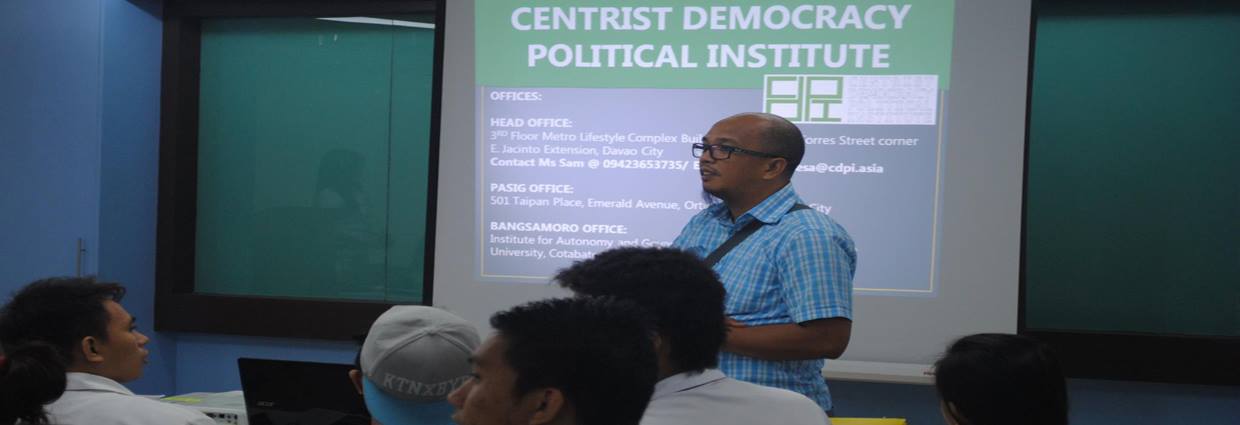
DAVAO CITY: The president of the Centrist Democracy Political Institute (CDPI) lamented the death of the "idea of federalism" in the Philippines, but urged fellow Mindanawons to "concentrate on how to make the BARMM (Bangsamoro Autonomous Region in Muslim Mindanao) successful" because "Mindanao's revenge against imperial Manila is for BARMM to succeed."
Lito Monico Lorenzana, CDPI president, chairman emeritus of Kusog Mindanaw and a columnist of The Manila Times, said there must be a "criteria of success" for the BARMM because while it is "not federalism per se," it can be the "start of something that may produce federalism."
"I am sorry to say that we federalists are a dying breed. More importantly, our idea of federalism is dead. Is dead. Please don't send flowers," Lorenzana said during the panel discussion on the "Roadmap for Federalism as a Mindanao Agenda," at the Kusog Mindanaw Conference on November 11.
The high-level panel, with another federalist, Michael Mastura, former congressional representative of Maguindanao and president of the Sultan Kudarat Islamic Academy, was tasked to "explore current developments and prospects in the House and the Senate on Charter change, particularly in the proposal for the shift to a federal system [and] generate steps that Mindanao advocates may take to help advance federalism."
The other panel members — Sen. Aquilino Pimentel 3rd, Senate majority leader during the Duterte administration and now Senate minority leader in the Marcos Jr. administration, and Rep. Rufus Rodriguez, chairman of the Committee on Constitutional Reforms — failed to attend the conference.
Lorenzana recalled how his fellow federalists, the late Abulkhayr Alonto and Reuben Canoy, opted for a Mindanao Independence Movement, noting that "if that caught fire, we would have been a federal Mindanao."
"The problem is we compromised. When we were in the cusp of an independent [Mindanao]," the national government feared it would lose the country's food basket and resource-rich area so it compromised, paving the way for the Autonomous Region in Muslim Mindanao (ARMM) and later the BARMM, which Lorenzana described as "panakip butas" (substitute or replacement).
Duterte dropped the ball
"Federalism as we envision it is dead," Lorenzana stressed, adding that there was already a president from Mindanao "who went on to win because of federalism, after which he dropped the ball" and there is a president now, who ran under the Partido Federal ng Pilipinas but has not said anything about federalism.
Mastura noted how Duterte "started very well with that promise" of amending the Constitution to allow for a shift to a federal system from the presidential-unitary system. "But he (Duterte) did not pursue it," marking the "death of the federal advocacy."
On the fate of the federal advocacy under the present Marcos administration, Mastura said: "This president now... what is his party? Federal. Is he talking about federalism? Not yet, I think never. So what do we do with him? So I'm trying to rabble-rouse here. You know I am a rabble-rouser. Always been."
Mastura had advocated for a federal system while a delegate to the 1971 Constitutional Convention.
He said he hopes Marcos "will pick up this idea of a federal setup immediately, while he is new in office."
Lorenzana said he does not see a silver lining, that they are "all frustrated" but hopes that from that frustration would emerge a seed of hope.
"That seed of hope is beginning to take ground. Or is that true?" he said, noting how the actor Robin Padilla, now an elected senator, is "on the right path" but has not called on the federalists to explain federalism to him.
"That guy never understood the wealth of wisdom between Mike and I for example... Robinhood has not even thought of talking to us. So, do you really think the guy will understand what federalism is? No, now if we have people like that in the highest echelon of government and does not even talk to those who understand federalism, then federalism is dead," he said.
Lorenzana's other woes are "there is no debate on federalism now" and "we have a president who ran under Federal and who does not know how to spell federal. Federalism is dead."
But in the latter part of his speech, Lorenzana said he saw some silver lining and "the silver linings here are the people."
'Good governance' root of federalism
He said the focus should now be on how to make BARMM succeed and a criteria of success of good governance in the BARMM must be made.
Among the "good governance" criteria he proposed are to "elevate" the poor in the region that hosts the poorest of the poor provinces by using simple poverty alleviation measures, peace and order, economic growth and food security.
"Talk about simple infrastructure build-up ... talk about how you can harness the OFW remittances, Simple things and that is how the BARMM will come up with something that is based on good governance" as this will "lead towards self-governance which is really the root of federalism."
Vice President and Education Secretary Sara Duterte, who gave the conference keynote address,, narrated her experience in Paquibato, Davao City, which was heavily influenced by communist rebels before.
"The antidote to war is good governance. And good governance builds public trust," she said. "That is something that I learned sa Paquibato. Good governance breeds public trust. When people see government officials working with integrity, with professionalism, and dedication to public service — they no longer see sense in causes that espouse violence."
Corruption is the enemy
At the turnover from ARMM to BARMM on Feb. 26, 2019, MILF chairman Al Haj Murad Ebrahim, who would be referred to by his real name, Ahod Balawag Ebrahim while serving as interim chief minister, vowed that the region would be ruled by "moral governance," a government that will "really be free of all the ills of governance."
"Now we acknowledge that we are entering another level of our jihad. Our jihad will be more intense and more challenging, our jihad firstly will be against our own self," Murad said. "Our enemies are all the ills of governance... our enemy is graft and corruption, our enemy is the manipulation of government, our enemy is nepotism, our enemy is all those ills of government."
In his inaugural address on March 25, 2019, Murad had said: "Our leadership over the BARMM and the BTA (Bangsamoro Transition Authority) is an amanah, a trust given to us and a responsibility for which we have to account for. Let us always be conscious of the day when we shall be asked of how we fulfill the trust and discharge the responsibilities."
At the Kusog Mindanaw conference, calls were made for more transparency and accountability in the BARMM amid criticisms that some officials are engaging in "the ills of governance." MindaNews
“Mindanao’s revenge against imperial Manila is for BARMM to succeed” – Lorenzana

DAVAO CITY (MindaNews / 13 November) – The president of Centrist Democracy Political Institute (CDPI) lamented the death of the “idea of federalism” in the Philippines, but urged fellow Mindanawons to “concentrate on how to make the BARMM (Bangsamoro Autonomous Region in Muslim Mindanao) successful” because “Mindanao’s revenge against imperial Manila is for BARMM to succeed.”
Lito Monico Lorenzana, CDPI President, Chair Emeritus of Kusog Mindanaw and a columnist of The Manila Times, said there must be a “criteria of success” for the BARMM because while it is “not federalism per se,” it can be the “start of something that may produce federalism.”
“I am sorry to say that we federalists are a dying breed. More importantly, our idea of federalism is dead. Is dead. Please don’t send flowers,” Lorenzana said during the panel on the Roadmap for Federalism as a Mindanao Agenda, at the Kusog Mindanaw Conference on Friday, November 11.
The high level panel, with fellow federalist, Datu Michael Mastura, former congressional representative of Maguindanao and President of the Sultan Kudarat Islamic Academy, was tasked to “explore current developments and prospects in the House and the Senate on charter change particularly in the proposal for the shift to a federal system (and) generate steps that Mindanao advocates may take to help advance federalism.”
The other panel members — Senator Aquilino Pimentel III, Senate Majority Leader under the Duterte administration and now Senate Minority Floor Leader in the Marcos, Jr. administration, and Rep. Rufus Rodriguez, chair of the Committee on Constitutional Reforms – failed to attend the conference.
Lorenzana recalled how his fellow federalists, the late Abulkhayr Alonto and Reuben Canoy, opted for a Mindanao Independence Movement but noted that “if that caught fire, we would have been a federal Mindanao.”
“The problem is we compromised. When we were in the cusp of an independent (Mindanao),” the national government feared it would lose the country’s food basket and resource-rich area so it compromised, paving the way for the Autonomous Region in Muslim Mindanao (ARMM) and later the BARMM, which Lorenzana described as “panakip butas” (substitute or replacement).
Duterte dropped the ball
“Federalism as we envision it is dead,” Lorenzana stressed, adding that there was already a President from Mindanao “who went to win because of federalism, after which is he dropped the ball” and there is a President now, who ran under the Partido ng Federal ng Pilipinas but has not said anything about federalism.
Mastura noted how Duterte “started very well with that promise” of amending the Constitution to allow for a shift to the federal system of government from the Presidential-unitary system. “But he (Duterte) did not pursue it.,” marking the “death of the federal advocacy.”
On the fate of the federal advocacy under the Marcos, Jr. administration, Mastura said: “This president now… what is his party? Federal. Is he talking about federalism? Not yet, I think never. So what do we do with him? So am trying to rabble-rouse here. You know I am a rabble-rouser. Always been.”
Mastura had advocated for a federal system while a delegate to the 1971 Constitutional Convention.
He said he hopes Marcos “will pick up this idea of a federal set up immediately, while he is new in office.”
Lorenzana said he does not see a silver lining, that they are “all frustrated” but hopes that from that frustration would emerge a seed of hope.
“That seed of hope is beginning to take ground. Or is that true?” he said, noting how the actor Robin Padilla, now a Senator, is “on the right path” but has not called on the federalists to explain federalism to him.
“That guy never understood the wealth of wisdom between Mike and I for example… Robinhood has not even thought of talking to us. So, do you really think the guy will understand what federalism is? No, now if we have people like that in the highest echelon of government and does not even talk to those who understand federalism, then federalism is dead,” he said.
Lorenzana’s other woes are “there is no debate on federalism now” and “we have a President who ran under Federal and who does not know how to spell federal. Federalism is dead.”
Lorenzana in the latter part of his speech said he sees silver linings and “the silver linings here are the people.”
Criteria for success of ‘good governance’
He said focus should now be on how to make BARMM succeed and a criteria of success of good governance in the BARMM must be made.
Among the “good governance” criteria he proposed are to “elevate” the poor in the region that hosts the poorest of the poor provinces by using simple poverty alleviation measures, peace and order, economic growth and food security.
“Talk about simple infrastructure build up … talk about how you can harness the OFW remittances, Simple things and that is how the BARMM will come up with something that is based on good governance” as this will “lead towards self-governance which is really the root of federalism “
Vice President and Education Secretary Sara Duterte, who gave the keynote address in the conference that morning, narrated her experience in Paquibato, Davao City which was heavily influenced by communist rebels before.
“The antidote to war is good governance. And good governance builds public trust,” she said. “That is something that I learned sa Paquibato. Good governance breeds public trust. When people see government officials working with integrity, with professionalism, and dedication to public service — they no longer see sense in causes that espouse violence.”
“Free of all the ills of governance”
At the turnover from ARMM to BARMM on February 26, 2019, MILF chair Al Haj Murad Ebrahim, who would be referred to by his real name, Ahod Balawag Ebrahim while serving as interim Chief Minister, vowed the region would be ruled by “moral governance,” a government that will “really be free of all the ills of governance.”
“Now we acknowledge that we are entering another level of our jihad. Our jihad will be more intense and more challenging, our jihad firstly will be against our own self,” Murad said, adding “our enemies are all the ills of governance… our enemy is graft and corruption, our enemy is the manipulation of government, our enemy is nepotism, our enemy is all those ills of government.”
In his inaugural address on March 25, 2019, Murad said: “Our leadership over the BARMM and the BTA (Bangsamoro Transition Authority) is an Amanah, a trust given to us and a responsibility for which we have to account for. Let us always be conscious of the day when we shall be asked of how we fulfill the trust and discharge the responsibilities.”
At the Kusog Mindanaw conference, calls were made for more transparency and accountability in the BARMM amid criticisms that some officials are engaging in “the ills of governance.”
House panel approves measure creating CAR

BAGUIO CITY: The House Committee on Local Government has approved House Bill (HB) 3267 authored by all Cordillera district representatives that seeks to establish the Cordillera Autonomous Region (CAR).
However, the panel led by Valenzuela First District Rep. Rex Gatchalian referred the proposed autonomy law to the House Committee on Appropriations and the Committee on Ways and Means for the approval of the financial aspect of the measure.
The approval of the bill on the committee level was done in the physical and virtual presence of the authors Abra Rep. Menchie Bernos, Apayao Rep. Eleanor Bulut-Begtang, Baguio City Rep. Mark Go, Benguet Rep. Eric Yap, Ifugao Rep. Solomon Chungalao, Kalinga Rep. Allen Jesse Mangaoang and Mountain Province Rep. Maximo Dalog Jr.
During the early stages of the proceedings, Gatchalian was inclined to order the creation of a technical working group that will look into the contents of the proposed autonomy law as he was of the impression that it was not passed on third reading during the 18th Congress.
But Mangaoang invoked Rule 10, Section 48 of the internal rules of procedures of the House, which provided that if a bill that was approved on third reading in the previous Congress will be refiled and will not be contested by any member or resource person, the same can be immediately passed by the concerned House committee dispensing of the deliberations as it is presumed that the matters have been extensively deliberated upon by the members of the House.
He added that the authors will work closely together to lobby for the immediate passage of the proposed measure with the House Committee on Ways and Means headed by Albay Second District Rep. Jose Ma. Clemente "Joey" Salceda and the House Committee on Appropriations led by Ako Bicol Rep. Zaldy Co.
The Kalinga lawmaker pointed out that the early passage of the bill in the committee level will allow the authors to have the time to work with President Ferdinand Marcos Jr. for the issuance of the important certification that this is a priority administration measure so that both chambers of Congress will act on the proposed measure with dispatch.
On Aug. 8, 2022, all the Cordillera representatives filed HB 3267 that seeks to create the CAR to ensure there will be sufficient time for it to be acted upon by the concerned committees tasked to render their approval of the measure, especially the financial provisions of the bill.
Last May 30, 2022, the House approved on third and final reading the consolidated HB 10729 seeking for the establishment of the CAR which will be composed of provinces and cities that will ratify the Organic Act during a plebiscite that will be scheduled for the said purpose.
On May 31, 2022, the approved House bill was subsequently referred to the Senate for the supposed passage of its counterpart measure in the upper chamber but it was too late considering that the 18th Congress had adjourned.
Mangaoang asserted that it is now time for the Cordillera to achieve autonomy so that it can catch up with the pace of development of other regions with the crafting of programs, policies and activities by the regional government, which are applicable to the context of the region to guarantee the desired progress for all.
The 1987 Constitution mandates the establishment of autonomous regions in Muslim Mindanao and the Cordillera through the enactment of enabling laws.
Kusog Mindanaw, bloody wars and BARMM

LAST November 11, Vice President Sara Duterte keynoted the Kusog Mindanaw Conference in Davao City. For the past 28 years, most conferences have been conducted in Davao, being the most convenient venue for participants coming from all regions and provinces of Mindanao from Jolo, Sulu, Zamboanga, Cagayan de Oro, the Cotabatos and the Davao provinces.
Kusog (dynamism/force) Mindanaw was a brainchild of Mindanaw NGOs — Technical Assistance Center for the Development of Rural and Urban Poor (Tacdrup), Mindanaw Congress of Development NGOS Network (Mincode) and Mindanaw Peace Advocates Conference (MPAC) — with the Konrad Adenauer Foundation (KAS). Born out of a grudge against the concept of "centralized everything" in Metro Manila, it was meant to counter this enigma and derisive local dictum of "imperial Manila."
A logical solution to this conundrum is federalism, the main pillar of Kusog, the longings for Mindanaw-nons to govern themselves (local autonomy), to plot the direction of their political lives without the control of the central government but still existing within the ambit of the Filipino nation. The urgency for the realization of federalism exists principally in Mindanao, and it bears the real cost of perpetuating the unitary system of government.
It was to this end that Kusog was created. It was meant to be a platform for consensus-building on Mindanaw-nons' concerns which invariably are as diverse and picturesque as the mishmash of cultures already in place by the mid-20th century. The founders opted to shape the debate on Mindanao. The exigency became apparent with the dark clouds of conflict and violence descending upon this "land of promise."
Seeds of conflict
It will be recalled that in the earlier part of the century, the Commonwealth government encouraged Filipinos from Luzon and Visayas to "go south" and populate the sparsely inhabited island with subsidized settlements and awards of hectares of choice arable lands. The post-World War 2 years from 1948 to 1960 drastically increased Mindanao's population, more than doubling the rate of the national average. As in many migrations since pre-Hispanic times, the displacement of the original inhabitants didn't input well into the socio-cultural equations. The largely Christian influx and encroachments into the Indigenous peoples, the aboriginals, the katutubo and the different Muslim tribes by the immigrants from the other islands in the Philippines, unrestrained and even abetted by government sanctions will later on prove to be contentious, erupting into violence and inter-cultural discords.
Thus, a vehicle on the mass base level for discourse initiated by nongovernment organizations, encompassing the various conflicted stakeholders was an imperative. An immediate effect of this dialogue among Mindanaw-nons was the unintended but welcome redirection of the internecine conflicts toward people in government — principally the centralized authority. This seething anger was further fed by the neglect by the central government until it burst at the seams. Various tribes and minority groups, principally the Muslims, translated such resentment into armed struggle. Antecedents of these conflicts go back to the Hispanic era where the sword and the kris crossed — the Catholic and the Muslim faiths. Upon the advent of the Americans, the suppression and conflict persisted, perhaps symbolized by the still widely unrecognized Bud Dajo massacre by the Americans of the Tausug tribe in Jolo.
Attempt at secession — MNLF
The subjugation and the Mindanao Muslims' long resistance against Hispanic and American rule and the various Philippine administrations induced leading royal families and sultanates to tolerate Hadji Kamlon's uprising in 1953, planting the seeds of separation and independence. People from both faiths agitated ineffectively for independence. Consequently, the Muslim Independence Movement (MIM) headed by Udtog Matalam established the first formal opposition to the Philippine government (GOP) in 1968. Unheeded, this eventually turned into a formal rebellion in 1969 in the formation of the Moro National Liberation Front (MNLF), led by Nur Misuari, a Tausug. President Ferdinand E. Marcos declared martial law in 1972. Subsequently the MNLF declared a formal rebellion. Blood flowed!
A series of peace negotiations went nowhere. But in March 1977, an agreement was hammered out in Tripoli, Libya, providing for autonomy for 13 provinces and nine cities in Mindanao and Sulu. This crucial provision was never implemented. Conflict resumed. Still, after the EDSA Revolution when President Cory Aquino assumed office, government and MNLF representatives signed the Jeddah Accord on Jan. 3, 1987. The MNLF agreed to abandon its campaign for independence in favor of autonomy for Mindanao. A referendum was held on Feb. 2, 1987 and failed. Hostilities resumed.
But a final agreement was signed in September of 1996 which provided for the establishment of the Autonomous Region in Muslim Mindanao (ARMM). Nur Misuari was appointed governor — but the warrior, successful in battle, was a failure in the bureaucracy. He conducted another failed rebellion and was driven to exile.
The MILF
In late 1977, Hashim Salamat, an MNLF leader, broke away from Misuari and established the MILF. Government troops and MILF forces clashed over the years, exacerbated by President Joseph Estrada's declaration of an "all-out war" against the MILF on March 21, 2000. During the intervening years, armed conflict in Mindanao was the norm, interrupted by a series of ceasefires and the death of MILF chairman Salamat, who was succeeded by Al Haj Murad Ebrahim. At the cusp of a peace agreement with the GOP, a splinter group of the Bangsamoro Islamic Freedom Fighters (BIFF), emerged as a dangerous irritant, culminating in that infamous Mamasapano massacre in 2005, exposing the incompetence of President PNoy.
All sides, probably tiring of the centuries-old conflicts, a final peace agreement was signed with the crafting of the Bangsamoro Organic Law, replacing the ARMM with the Bangsamoro Autonomous Region in Muslim Mindanao (BARMM) in February 2019.
Seeds of federalism and discord
The BARMM as composed may partially answer the longing for federalism. Born out of an organic law by the GOP, it provided for the establishment for an autonomous administrative region composed of predominantly Muslim provinces: Basilan, Lanao del Sur, Maguindanao, Sulu and Tawi-tawi. As presently structured, the BARMM exists within the laws passed under the 1987 Constitution. Those skeptical of the BARMM maintain its creation as unconstitutional, arguing that powers given to it are solely reserved for the Philippine Congress — and therefore can be taken away! Other objections run the gamut of illegal taxing powers of BARMM to the disadvantage of other regions. But the ticklish provisions are those that involve the indigenous inhabitants who are neither Christian, Catholic nor of the Islamic faith. They are at a disadvantage and vulnerable to the Muslim-controlled BARMM government. And more importantly, to the application of the Shariah law to all Muslims although this does not apply to the non-Muslims within the territory.
But there are serious implications and apprehensions. Even now comparisons are being made to a similar autonomous region perceived to be failing: the Special Administrative Region (SAR) of Hong Kong within China. Similar to the BARMM, Hong Kong maintains separate legal, administrative and judicial systems from the rest of China, from the time it was separated from Great Britain in 1999. Since then, its political freedoms and cultural life have been reverted back to China.
Many people in and outside of Mindanao believe that BARMM will eventually suffer the same fate as Hong Kong.
To be continued next week, Nov. 23, 2022
The politics of Senate hearings

THE Senate committee on accountability of public officers, or the blue ribbon committee (BRC), has been the bane of scoundrels and corrupt officials in government. Touted as the most powerful congressional committee, the BRC was created to investigate irregularities in the executive branch, its attached agencies, government-owned corporations and parastatals. But over time, in the mold of traditional politics in this country, it is perceived to have evolved simply into a platform for politicians propelling their personal agenda. The chairman is projected as an alpha senator — appearing to be the equal of — or a wannabe president himself.
The BRC can summon any person in the bureaucracy and from the private sector. However, it does not have the power to incarcerate witnesses and lying resource persons except for contempt of the Senate. But the biggest advantage to the chairperson is his debut to a much wider stage and larger national audience — free publicity at no personal expense — investigating scandals, anomalies and whatever disturbs the equanimity of the powers that be — even those in the oligarchy. In short, there is a strong compulsion to turn this into a grandstanding platform impelled by the glare of TV camera lights, the proceedings dictated more by news deadlines and prime time TV slots, bludgeoning the witnesses, leaving some reputations in tatters. A premium post, pro- and anti-administration demagogues vie for television time allowing them to preen and strut before the cameras. All such investigations are being pursued "in aid of legislation."
Antecedents
The BRC's storied past started during President Elpidio Quirino's administration. Sen. Justiniano Montano of Cavite, Quirino's Liberal Party mate but also a rival, formed a clique — "the little Senate" that proved to be a thorn in the side of the president. This precedent, born out of spite, has since become a tool for a senator who wants his head raised above the rest.
More often than not, there is a bizarre rule of thumb in the BRC hearings: the BRC of a new regime investigates the past regime's alleged anomalies if both are on opposite camps; or the current Senate and the president are "kontra-partido"; or an ambitious senator uses the hearings to advance his agenda, irrespective of their party affiliation or alliances.
Among the celebrated BRC investigations were the PEA-Amari scam involving the overpriced purchase of reclaimed land in Manila Bay. Then senator Ernesto Maceda exposed it as the"the grandmother of all scams." The anomalous deal occurred during the incumbency of President FVR and his factotum, Speaker Joe de Venecia. Under FVR's successor, President Erap's BRC cohorts investigated the so-called Expo Filipino scam, for allegedly excessive amounts of money poured into the project. FVR was cleared.
President Gloria Macapagal Arroyo has the greatest number of serious BRC investigations, among them the fertilizer fund scam causing the resignation of her agriculture officials; the NBN-ZTE deal that netted the alleged "bagman" her erstwhile Comelec chairman; and the Hello Garci scandal that involved her allegedly rigging election results in her favor.
President PNoy had the Disbursement Acceleration Program (DAP) scam, and the Janet Napoles fund diversion anomalies, and the deadly Mamasapano massacre.
And President Duterte had the immigration and customs bureaus' bribery and smuggling cases; the Dengvaxia controversy; the PhilHealth corruption scandals; and the biggest during his watch, the Pharmally scandal.
Pharmally anomalies
This case is taken here at length for two reasons: the clear and direct defiance of the Deegong, directing his Cabinet not to cooperate with the BRC investigation, and the involvement of foreign nationals at a time of the greatest worldwide emergency situation — the Covid-19 pandemic.
What was established in those unprecedented 18 hearings were: the Pharmally Pharmaceutical Corp (Pharmally), a company with a small paid-up capital of P625,000 and with no track record, managed to corner nine contracts worth P8.68 billion of substandard quality PPE. An attendant anomaly was the illegal transfer of P41.4 billion funds by the Department of Health to the Procurement Service of the Department of Budget and Management (PS-DBM). Behind these transactions was the so-called Davao Mafiosi of Christopher Lao, an obscure lawyer, DBM undersecretary and alleged Sen. Bong Go stooge (SBG denied this vehemently) who was transferred to head the PS-DBM (TMT, Sept 8, 2021).
Hovering over Pharmally was Michael Yang. "This shadowy figure, not even a Filipino, was privileged an appointment as President Duterte's 'economic adviser." (TMT, Sept. 15, 2021).
What added drama to these hearings was the adversarial chairman, Dick Gordon. The man was a master at squeezing the last drop of the hearings' PR content at the expense of the Deegong and his subalterns. At the end of the day, nothing happened! The Deegong's Senate cohorts junked the committee report. The miscreants went back to China. And Senator Gordon lost his reelection bid.
BBM'S folly
Weeks into his administration, BBM run smack into the machinations of his trusted lieutenants, Executive Secretary Vic Rodriguez and spokesperson Trixie Angeles (TMT, Oct 26, 2022) that triggered a BRC investigation headed by Sen. Francis Tolentino, a political ally and former partymate of Duterte. Apparently "...there has been a noted shortage of supply of sugar in the domestic market of the Philippines after a poor harvest for the 2021–22 crop year. This led to the price increase of the commodity and there were suspicions of traders taking advantage of the situation through hoarding. A plan to import 300,000 MT of sugar through Sugar Order 4 was also subject to controversy which led to the resignation of officials of the Sugar Regulatory Administration (SRA).
The BRC hearing arrived at the conclusion that the shortage was artificial and manipulated by big-time traders — and hoarders. Short of sacking officials from Malacañang and the Agriculture department, the powerful SRA remained intact, powerful and probably waiting for the next strike.
'Pricey, outdated' laptops
The second BRC hearing conducted by Chairman Tolentino involved the anomalous purchase of computer laptops for teachers. The Commission on Audit (CoA) has flagged the Education department (DepEd) for spending P4.5 billion. What was curious was the involvement of the DBM-PS — the same conduit for anomalous transactions on the Pharmally investigations. The same modus operandi was used under the Republic Act 11494, or the "Bayanihan to Recover as One Act." The DBM-PS struck again with the questionable procurement of the laptops.
What is unconscionable was the subsequent declaration of Tolentino that "...individuals conspired 'to pocket' public funds allotted for the purchase of laptops for public school teachers for online teaching at the height of the pandemic."
But then he promptly terminated the investigation, saying sheepishly, "It's quite complicated. The conspiracy angle is still there." Tolentino is either too lazy to pursue the investigation to its logical conclusion — or something fishier is in the offing. The good senator was the Deegong's man, and these anomalies happened on Duterte's watch.
BBM can pursue these investigations — using the full force of the law after all the grandstanding. He has enough evidence to push through.
But will he?
Philippine SMEs win big in Asean Business Awards

SMALL and medium enterprises (SMEs) from the Philippines recently scored big in the Asean Business Awards.
Go Negosyo founder Jose Ma. "Joey" Concepcion 3rd said the Home Healthlink Innovations, Felta Multimedia Inc. and Esquire Financing bested other SMEs from the region in their respective categories.
Home Healthlink Innovations and Felta Multimedia Inc. won the top prizes in the SME Priority Sector Healthcare and SME Excellence in Innovation categories. Esquire Financing romped off with a special award for its role in MSME financing.
They joined other winning SMEs from Cambodia, Myanmar, Indonesia, Malaysia, Thailand, Brunei Darussalam and Singapore.
Concepcion said the local firms' victory demonstrates the innovation and passion of Filipino SMEs.
"There are 71 million MSMEs in the Asean region, accounting for almost all of the total establishments. In the Philippines, these small entrepreneurs also account for a large majority of the total enterprises. Considering their important role in job generation and in our collective economic recovery, we must continue to support them," Concepcion, the Asean Business Advisory Council (BAC) chairman for the Philippines, said in a statement Sunday.
Felta Multimedia President and CEO Mylene Abiva said the recognition is a testament to the company's pioneering excellence in robotics technology education in the country and a reward for introducing new teaching methods, tools and curriculum in both public and private schools.
"Receiving the Asean Business Awards 2022 for SME Innovation is a validation of our emphasis on science, technology, and innovation as a critical enabler for sustainable development, particularly on economic growth, social development, human resource capital, technology-driven jobs revolution and environmental sustainability in Asean," Abiva said.
Home Healthlink's success was attributed to its efforts to provide quality transitional, intermediate, health rehabilitation, wellness, standalone, and palliative care for house-bound patients.
"Receiving this award has only given us more drive and inspiration to continue fulfilling our mission of providing safe, convenient, responsive, cost-effective, and caring hospital-grade medical services from the comforts of one's own home," said Home Healthlink CEO Dr. Sheila Acosta.
Esquire Financing was recognized for providing collateral-free loans for small businesses, becoming one of the country's leading providers of loans to SMEs.
Even during the pandemic, the company continued lending to businesses, and has vowed to partner with the Philippine government to help businesses recover.
Esquire also operates a nonprofit microfinancing arm, Help Foundation.
The annual Asean Business Awards recognizes outstanding and successful enterprises that contribute to the region's economic growth and prosperity.
Concepcion said the Asean Mentorship for Entrepreneurs Network, or AMEN, the legacy project of his chairmanship of the Asean BAC, continues to be actively expanded and sustained across Asean.
AMEN is a public-private partnership platform that supports regional MSMEs through mentorship and training based on modules used by the Go Negosyo program Kapatid Mentor Microenterprises.
Phase 1 of the initiative was piloted in Indonesia, Malaysia and the Philippines while Phase 2 is set to be implemented in the entire region with the support of the Japan-Asean Integration Fund.
The Asean Business Awards is designed to encourage regional cohesiveness and global competitiveness.
4 PDP-Laban Senate bets want federalism, constitutional reforms

MANILA – At least four senatorial candidates of the ruling party, the Partido Demokratiko Pilipino-Lakas ng Bayan (PDP-Laban) on Saturday expressed support for the proposed shift to federalism and amendments to the 1987 Constitution.
Senatorial aspirant Astra Pimentel backed the planned shift from the current unitary to a federal form of government, saying it will spur more economic activities and help address poverty and corruption.
The proposed federal type of government is included in the PDP-Laban’s 11-point agenda, Pimentel said in a joint statement.
"Alam naman natin ang (We all know that the) PDP-Laban has dreamed for a country to have federalism for many years already," she said. “And there are many who already expressed their full support to change the form of government and to amend the present constitution because accordingly it should serve the people but the existing law prevents it.”
Pimentel stressed the need to correct the supposed infirmities of the present constitution that “does not truly reflect the aspiration of the Filipinos and averts the government to help people.”
Former chief presidential legal counsel and now senatorial hopeful Salvador Panelo, in the same statement, explained that the shift to federalism would empower and give independence to local government units (LGUs).
LGUs, Panelo said, no longer need to “beg or be at the mercy of an overly centralized government,” once a federal set-up is implemented.
“You have to redistribute powers coming from the national government at ibigay natin sa mga lokal upang maging independent sila (and give it to local governments to make them independent). Mayroon silang kakayahan, mayroon silang sariling development na hindi umaasa doon sa itaas (They are competent and have the ability not to rely on the national government),” Panelo said.
Panelo along with other PDP-Laban senatorial candidates are willing to immediately step down from office in case they win the senatorial race for the immediate implementation of a federal form of government.
Senatorial candidate Rey Langit also expressed support for the proposed shift to federalism, calling it the “right form of government for Filipinos" and that the country is “already ripe” for a federal type of government.
“Maraming butas sa kasalukuyan nating Saligang Batas ang mawawala sa pamamagitan ng federalism (The loopholes in our Constitution will be addressed if we shift to federalism)," he said.
Senatorial hopeful Greco Belgica said there should be “clear-cut reforms” that must be attained if the change in the form of government takes effect.
Pimentel, who served in the government for over 20 years, said she would push for the passage of the proposed Magna Carta for Barangay Officials and the Barangay Reform Act to address the “imbalance among regions.” (PNA)
The gatekeepers, Philippine version

Last of 2 parts
AMERICAN presidential politics are where we patterned our own, except that in most cases, the Filipino penchant for adopting form rather than substance was the overarching consideration. Thus, when our American colonials imposed on us the presidential-unitary system of government, we incorporated this into the 1935 Philippine Constitution. The 1974 Marcos Constitution subsequently sought to abrogate this model and fashioned a mongrelized version of a strong presidency within a parliamentary system. It was touted at that time that Marcos père idolized the French parliamentary model with a strong presidency – personified by Charles de Gaulle. Thus, in Ferdinand's opus, he introduced the parliamentary system in the Philippines installing himself as the strongman and established the Batasang Pambansa — with Cesar Virata, the technocrat as the prime minister and political castrate.
Cory came in with her 1987 Constitution ambivalent on the populist government to espouse. Rejecting the Marcos prototype, the Cory Constitution reinstated the unitary-presidential system, and along with the core concept of American republicanism and democracy and its integral configuration; the sacrosanct separation of powers associated with checks and balances which were meant to provide each branch of government — the executive, legislative and the judiciary — with individual powers to check the other branches preventing any one branch from becoming too powerful. In our case, the office of the president was constitutionally enhanced evolving as the more powerful branch. Thus, its head, the Philippine president is ascendant and by inference, the people existing within the penumbra of that office.
Executive branch
Briefly, in a republic, the president is the head of state, the head of government and the commander in chief of the armed forces. He is responsible for implementing and enforcing laws emanating from both houses of congress (legislative). Principally, the president runs government through the cabinet, his alter egos, who must have his complete trust and are expected to speak for and in his behalf in their areas of expertise. Such responsibility is a privileged one. I wrote then, "...the bond between the cabinet and the president is no longer a personal one as in — classmates, schoolmates or 'tsukaran.' It has transcended the familiar and morphed into one containing the majesty of the office of the presidency.
"By this precept, both are custodians of presidential prerogatives, prestige and power, adding their own to it to enable the president and them to do their tasks well. The sum of all these is the vaunted fragile political capital of the president with a sustainability dependent largely on a fickle citizenry.
"Cabinet members are heat shields and political lightning rods of the presidency. As such, part of their job is to deflect serious criticism from their respective publics and clientele from the presidency as a result of their official functions. As an efficient conductor of political heat, these honorable secretaries must prevent damage or serious erosion to the political capital of the presidency."
US chief of staff (COS)
In the book The Gatekeepers (Cris Whipple, 2010), the closest person to the American president is his chief of staff (COS). It describes the workings of the American COS of 10 administrations from Presidents Eisenhower to Richard Nixon to Barack Obama, eliciting the salient qualities that make for the desired COS. For this column's purposes, focus is on Nixon's Haldeman, their relationship and how it impacted not only the workings of the office of the president itself but the whole government. From thence, we may draw some features that differentiate the COS from the Philippine executive secretary (ES) — and perhaps adopt the positives.
The antecedents of the COS go back to the time of the President Dwight Eisenhower. Prior to his presidency, he was the top allied general that won the war in Europe. "...Sherman Adams was the first COS and reportedly 'wield as much power as his boss.'" He was in the mold of what Eisenhower has been used to: army chiefs of staff.
Similarly in the Nixon-Haldeman tandem, the latter's proximity to the flawed and vindictive president conferred on him an aura of unprecedented power and in return Haldeman was "...fiercely loyal, selfless and protective of his principal," the most desired trait of a COS.
Haldeman understood only too well that "the president's time is his most valuable asset." This precious presidential commodity should be sparingly expended, resulting in many decisions arrogated by the COS, a double-edged sword at best.
Haldeman was so jealous of his prerogative that none was permitted to meet with the president privately without going through him. The president's time is best used making decisions himself and not presiding over the decision-making process or squabbles of the staff. The quality of a good gatekeeper is the farming of what are major considerations to the president. Minor ones are for the staff to decide upon.
Thus, Haldeman as gatekeeper redefined the job of those that serve the president as one that is "not to do the work of government, but to get the work out to where it belongs — out to the Departments. Nothing goes to the president that is not completely staffed out first..."
It is noteworthy that the Nixon-Haldeman tandem resulted in the biggest debacle of any American presidency, the Watergate break-in, that eventually buried the Nixon presidency.
BBM'S office
It could be portentous that in the first 100 days of BBM's presidency, a period technically the "honeymoon interlude," it was racked by scandals. Many attributed it to BBM's misappreciation of his office or worse, the emergence of character flaws his father noted in that famous June 12, 1972, handwritten note, "...Bongbong is our principal worry. He is too careful and lazy." Perhaps this was just a loving father's apprehensions oover his son's demeanor.
Thankfully, this mess involving ES Vic Rodriguez and spokesman Trixie Angeles was cut in the bud by BBM's other gatekeepers, presidential legal adviser Juan Ponce Enrile and presumably the timely intervention of the wife — Liza — if credence is placed on Palace rumors. Now, a new gatekeeper, retired chief justice Lucas Bersamin, has just been hastily installed.
Not much is known of Bersamin except for his short and not so stellar occupancy of the Supreme Court, obfuscated by his involvement in controversial decisions and ponencias. He voted in favor of the burial of the former dictator in the Libingan ng mga Bayani; ruled in favor of extending martial law in Mindanao; supported the controversial quo warranto case against former president Benigno S. Aquino 3rd's appointed Chief Justice Maria Lourdes Sereno; supported the acquittal of former president Gloria Macapagal Arroyo; and the grant of bail for the imprisoned former senator Juan Ponce Enrile. The last may be significant as Enrile is now the chief legal counsel of the president.
None of Bersamin's qualifications hint on how he will be effective as ES. But considering the early fiascos at the OP, reflective of its inadequacies, the hovering role of a strong wife, who even now is unfairly being compared to the once formidable senior Marcos' wife, Imelda; and the indestructible methuselah of Philippine traditional politics, Enrile; perhaps an adult hovering over BBM and the OP could be a welcome development.
And I hope he reads Whipple's The Gatekeepers — and learns from it!
Categories
Archives
Comments
-
 This is really interesting, You're a very skilled blogger. I've…
Written by Merrill
on Thursday, 24 March 2016 12:35
Incompetence Kills
(LML Polettiques)
This is really interesting, You're a very skilled blogger. I've…
Written by Merrill
on Thursday, 24 March 2016 12:35
Incompetence Kills
(LML Polettiques)

Newsletter Subscription
PARTNERS:


Contact Us
+63 (02) 470-9076 Pasig
F. Torres Street Corner Jacinto Extension,
Davao City, 8000 Philippines
Jr. Road Ortigas Center, Pasig City
